


Concept and Overview
RonAgent is the world's first L4-level enterprise management agent, it restructures business processes through AI-native architecture. Capable of autonomously generating agents based on roles, tasks, and intentions, it excels in task planning, environmental awareness, collaborative operations, tool invocation, and continuous learning. This system supports comprehensive AI applications across enterprise management, enabling a paradigm shift from task execution to goal-driven operations.
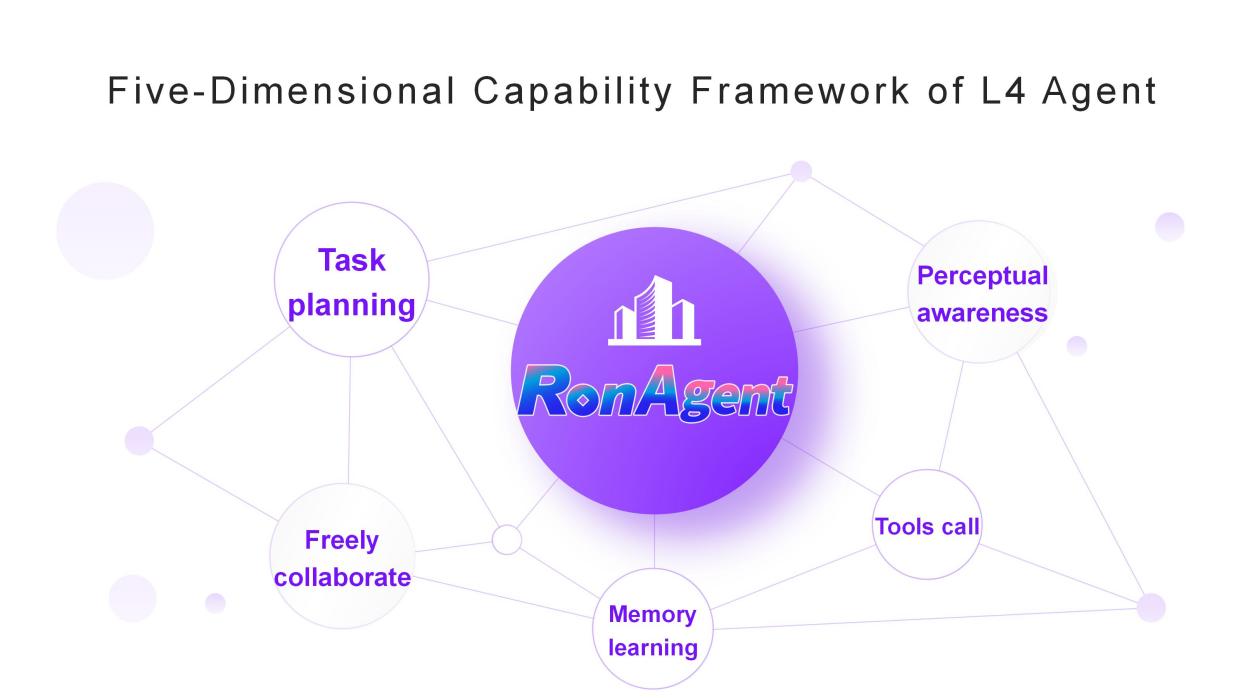
Task planning ability
Complex task decomposition: Breaking down user requirements into executable subtasks
Dynamic Inference Decision-Making: A ReAct Framework for Continuous Iteration of "Thinking-Acting-Observing"
Multi-path exploration optimization: Utilizes the Tree of Thought (ToT) technique to evaluate multiple solutions in parallel, supporting path backtracking and strategy adjustments.
Perceptual awareness
Deep intent understanding: Accurately identify dynamic intent by combining user identity, permissions, and conversation history
Multi-modal Information Processing: Supporting Cross-modal Information Fusion such as Image Recognition and Speech Analysis
Intelligent Interface Interaction: With GUI operation capability, it achieves the interactive breakthrough of "UI as API"
Context awareness: Fully understand user preferences, history, and environmental information such as time and location
Adaptive Response: Real-time Adjustment of Action Strategies and Decision Recommendations Based on Environmental Changes
The ability to collaborate freely
Multi-agent Collaborative: Autonomous Division of Labor Based on Task Objectives to Break Through the Limit of Fixed Workflow
Full-process status tracking: Real-time monitoring of task progress and information completeness
Intelligent fault tolerance: actively identify uncertainties, initiate precise inquiries and clarifications, and ensure task reliability
Tool call capability
Standardized tool library: Clearly define tool names, function descriptions, and input/output specifications
Dynamic selection mechanism: intelligently matches the optimal tool based on task requirements and supports hierarchical routing management
Intelligent fault tolerance: Analyzes errors, self-correction, and tool replacement to ensure stable execution
Memory learning ability
Short-term memory maintenance: Maintaining information coherence in single tasks through contextual windows
Long-term Knowledge Accumulation: Constructing a Persistent Knowledge System Based on Vector Database and RAG Technology
Continuous learning and evolution: Enables user feedback learning and RLHF optimization to continuously improve behavioral patterns
These five dimensions collectively form the core capability loop of L4-level agents, driving their evolution from simple response tools to fully autonomous systems with complete cognitive capabilities.
Architecture and main functions
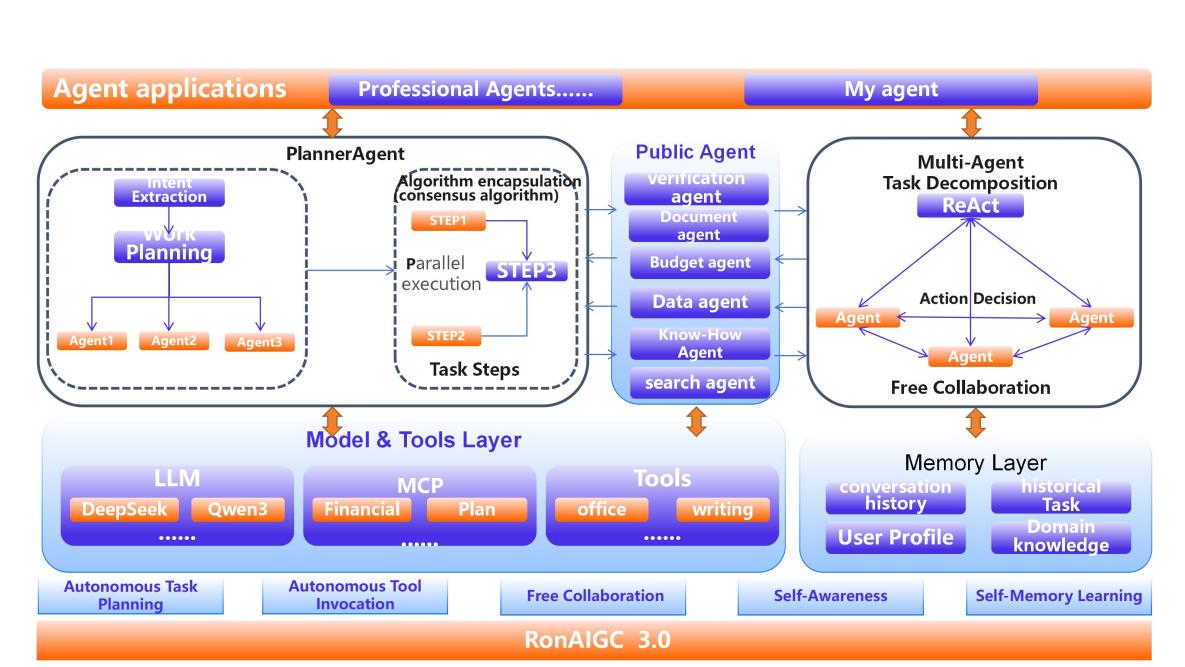
RonAgent is a collective system comprising multiple agents with distinct roles, application scenarios, and user demographics, with the following core component:
• Task Planning Agent (PlannerAgent): Accurately identifies user intent to automatically decompose tasks, generate steps, and orchestrate workflows.
• The Controller Agent autonomously learns corporate policies and regulations, converting them into control rules to monitor employee behavior, decision-making processes, and system collaboration in real time, thereby establishing a multi-tiered compliance supervision system.
• Data Agent: Automatically processes and annotates historical and real-time data to generate LLM-comprehensible contexts, enabling enterprise-level profile construction and analysis.
• Agent-to-Agent Communication and Collaboration (A2A): Establishing an A2A communication framework based on organizational structures, roles, and permissions to enable efficient cross-agent collaboration. Ronhe Technology is developing an autonomous communication encoding generator, aiming to explore and contribute to the development of future industry-wide standards.